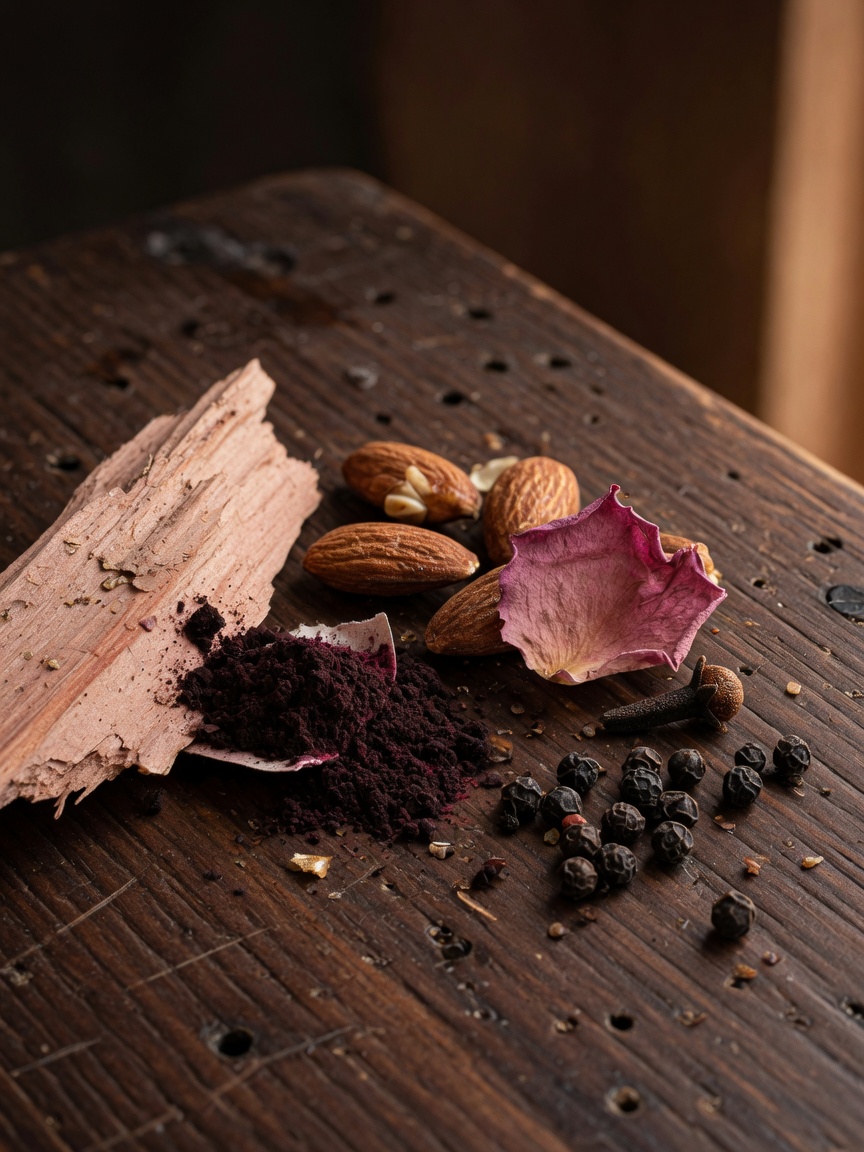
On a weekday evening in November 2023, I was doing "reference training" at my desk. On the table were: sliced raw almonds, a small piece of unfinished cedar wood, half a spoon of light cream, crushed black pepper, a small dried rose, and potting soil lightly touched with a wet tissue. The room temperature was about 23°C, and outside the window was the dry air of early northern winter. I closed my eyes and smelled each one, then opened my note-taking app and wrote three words for each scent. When I got to "soil," I was stuck for nearly two minutes — I could only think of "earthy," unable to distinguish between "freshly plowed field" and "damp basement wall."
The hardest step in tobacco aroma training is often not "judging whether it smells good or bad," but breaking a cloud of smoke into words that can be repeated, compared, and understood by others. Marketing copy likes to write "rich layers, elegant complexity"; factories and research teams use attribute words + intensity scores such as nutty, woody, floral, creamy, caramel. In mainstream cigar smoke research published around 2024, sensory experts agreed on descriptors for multiple samples, including nutty, beany, coffee, cocoa, woody, fruity, clean sweet, caramel, honey, floral, creamy, resinous, hay, leather, and more than a dozen others, scored on a 0–5 intensity scale. On the instrument side, compounds can be grouped by odor description into nutty, caramel, smoky, woody, floral, fruity, creamy, sour, and other series. For ordinary people, you don't need GC-MS, but you do need the same "dictionary" and a set of nose-and-mouth decomposition techniques.
First, set the boundaries:
- Being able to describe aromas does not reduce health risks. Clear woodiness, smooth creaminess, or refined earthiness does not equal "safer." Burning or heating tobacco products still carries nicotine dependence and multiple harmful exposures.
- Description is subjective mapping; vocabulary is a public convention. What you smell is your personal olfactory memory; people can discuss it because they have agreed on references like "cedar-like woody" or "roasted almond-like nutty."
- Environment rewrites results. Perfume, coffee, freshly brushed toothpaste, nasal congestion, empty or full stomach, and low relative humidity can all turn the same cigar into a completely different face.
- This article does not teach you how to enjoy smoking better; it only teaches structured recording. If you are quitting or have never smoked, there is no need to practice with actual smoke; reference training (nuts, wood strips, spices) is sufficient to understand the classification logic.
- Mistaking box wood absorption scent for the leaf's main aroma
- Misreading dry harshness as "high woodiness"
- Confusing moldy/damp wood with "precious aged wood"
- Writing burnt/scorched as nutty
- Writing rancid oxidized oil as "strong nutty"
- Imagining mild sweetness on an empty stomach as nutty
- Equating low harshness directly with creaminess
- Confusing added milky aroma with the leaf's natural roundness (more common in flavored cigarette context)
- Nasal congestion makes "creamy" almost undetectable, leaving only an oily illusion in the mouth
- Nicotine/smoke harshness ≠ spicy. Harshness isprickle,harsh, throat tightening; spiciness is a aromatic stimulation that reminds you of spices.
- Writing ammonia harshness as "white pepper."
- Mistaking perfume residue for smoke floral aroma
- Beautifying green/grassy as floral
- Forcing the discomfort of high-concentration indole-related "fishy floral" into elegant floral
- Moldy smell, damp cardboard, basement written as "aged earthy"
- Dust/ashiness written as earthy
- Directlyembellish unpleasant earthyfishy note as "breath of earth"
- No perfume, no scented hand soap; hands clean and completely dry.
- No strong coffee, no mint candy, no smoking (if you are already quitting, stay quit).
- Allergic rhinitisattack or severe nasal congestion: reschedule — forcing it will only yield "all harshness."
- Room ventilated but without strong drafts; ideal is relatively stable temperature and humidity (industry storage often mentions balanceapproach around 20–22°C, about 60%–70% relative humidity; households can't reach lab level, at least avoid direct heater blast and sauna-level dampness).
- Prepare plain water and unsalted soda crackers to cleanse the palate; open recording template.
- Take in a small amount of smoke, don't use your chest cavity as a bellows.
- Close mouth and hold for about 2–4 seconds (no need for precise stopwatch, but have theawareness of "pausing").
- Gently exhale through nose or use retro-nasalpassage with mouth closed: at this point floral, nutty, sweetness are often clearer than pure oral.
- Score by items instead of writing prose first:
- Cold scent 30 seconds: First nosewith a dry wood, second nose had mild sweetness. Recorded: woody 2, sweet 1; suspicious box influence.
- Let burnstable for about 2 minutes before evaluating (first minute only observed burn line, no aroma notes, to reduce "lighter/overheat" interference — this isrule of thumb in home scenarios).
- Head section: Retro-nasal had weak nutty, mouthwith a dry. Recorded: nutty 2, woody 2, creamy 0, throat harshness light.
- Mid section (around 15 minutes): Smoke became slightly smoother, earthy suspected 1–2, pepper pointprickle 1. Here I made a mistake: continuous hot sniffing too frequently, eyes and nose were overwhelmed, I wrote harshness as spicy 3.
- Rest 3 minutes, look out the window, drink water. Re-evaluated: spiciness dropped to 1, earthy still at 2, woody stable 2–3.
- Tail section: Burnt sensation increased, nutty became "a bit burnt," following discipline I lowered nutty from 2 to 1, and noted burning was accelerating.
- Aftertaste about 8–10 minutes: Tongue surface slightly bitter, woody residue, no mold.
- Sensory evaluation can simultaneously score "quality score" and "style attribute score"; having clear attributes does not equal subjective preference.
- Instrument-confirmed key contributors (high OAV) often align with panel-prominent attributes, e.g., some samples' prominent woodiness correlates with cedrol-type description, nutty/coffee correlates with specific aldehydes and pyrazines — this only shows that the human nose is not mysticism, not that you need to do mass spectrometry at home.
- The idea of shared vocabulary is homologous with wine aroma wheels and e-liquid flavor wheels: classify first, thensubdivide, then discuss preference.
- Writing cedar box flavor into "the soul of the leaf." Cold scent first question the container.
- Treating harshness as spiciness, treatingharsh as character. Record in two columns.
- Beautifying mold as aged earthy. A defect is a defect.
- Perfumed hands, coffee tongue in action.equals to blind evaluation.
- Giving only one adjective for the whole cigar. No timeline means noreview.
- Score inflation. All 5s equals no differentiation.
- Insisting on "caramel nutty" when burningalready off. Fix the burn and rhythm first, then write flavor.
- Treating describing ability as a safety certificate. No matter how precise the flavor notes, they cannot change the basic fact of harmful exposure.
I. Where Does Tobacco Aroma Come From: Four Layers offour superimposed layers, Not "Leaves Naturally Spray Perfume"
Understanding aroma as four superimposed layers is more useful than memorizing brand stories:
| Layer | General Content | Impact on Description | |-------|-----------------|----------------------| | The Leaf Itself | Precursor differences from variety, region, part, and maturity | Determines whether the "skeleton" leans toward clean sweetness, heaviness, or green/grainy notes | | Curing & Fermentation/Aging | Flue-curing, air-curing, sun-curing,stack fermentation, aging | Ammonia decreases, sweetness and roundness increase; earthy/leathery/beany narratives become more common | | Burning or Heating Moment | Pyrolysis, Maillard reaction, distillation transfer | Produces nutty pyrazines, phenolic smoky notes, woody alcohols/ketones, floral alcohols, etc. | | Storage & Utensils | Cedar boxes, leather cases, refrigerator taint, excessive humidity | Cold scent often hits "box wood" first, easily mistaken for the leaf's main aroma |
A simple fact repeatedly appears in published research: different samples can have very similar compound types, but their content and contribution (e.g., OAV) can differ greatly. So sensorially you might feel "they all taste like cigar," but upon detailed breakdown, one leans toward cedrol-style woody, one toward methylbutanal/pyrazine-style nutty/coffee, and one toward phenylethanol-style floral sweetness. The task of description methods is to advance from "it feels different" to "I can point out what category, what stage, and how strong the difference is."
My view is straightforward: Practice classification and intensity first, then poetic adjectives. "Like a Caribbean sea breeze at dusk" cannot be aligned with others; "mid-section woody 3, nutty 2, finish earthy 2, throat irritation moderate" can.
II. Six Common Aroma Types: Definition, Reference, Location, and Easily Confused Points
The following six categories are the most frequently occurring in tobacco contexts and the best for beginners to establish a coordinate system. Each category provides a reference — this is a practice I have insisted on since that desktop training in winter 2023: without references, vocabulary degrades into "smells nice" within three months.
1. Woody
What it's like: Sharpened pencil, unfinished cedar, dry oak board; occasionallywith a cypress-like cool edge, occasionallywith a damp-wood heaviness.
Suggested reference: Cedar strip, pencil shavings, clean raw wooden cutting board (avoid paint and essential oils).
Common location: Common in cold scent and mid-to-late stages; products stored in cedar boxes may have amplified woodiness in cold scent.
Easily confused:
Personal view: Woody is one of the easiest skeletons to recognize in tobacco, but also the most easily fooled by environment. In March 2024, I cold-scented a sample stored in a cedar box at about 45% relative humidity — the first nose was all box; after the same sample was balanced at about 65%RH for two days, the cold scent revealed the leaf's own sweetness. So in notes, I force myself to add one more line: "Woody sourcesuspicious: box / leaf / both?"
2. Nutty
What it's like: Roasted almond, raw walnut skin, cashew; sometimeswith a roasted nut character of coffee beans/cocoa.
Suggested reference: Lightly roasted almond, compare with raw almond, roasted coffee beans (don't smell too long, olfactory fatigue sets in easily).
Common location: Moreclear in mid-section smoke; often appears together with caramel, beany, cocoa.
Chemicalpopular science anchor (no need to memorize formulas): Pyrazines related to Maillard reaction are often described as roasted, nutty; certain aldehydes also carry bitter almond/cocoa direction narratives. In research and sensory panels, nutty is almost a "residentattribute" of cigar smoke.
Easily confused:
Failure record: In summer 2022, during an informal comparison, I wrote "a bit burnt" as "deep roasted hazelnut." The next day, comparing with real roasted hazelnuts, I admitted the previous day was scorching from too rapid puffing and high temperature. Since then, I set a rule: when burningstate is abnormal, downgrade nutty descriptions.
3. Creamy
What it's like: Light cream, warm milk skin, smooth fatty sensation; not the cloying sweetness of vanilla ice cream.
Suggested reference: A small spoon of light cream (room temperature), the milk skin scent of warm whole milk.
Common location: More reflected in mouthfeel structure — the smoke becomes "round, smooth, less angular"; cold scent sometimes only has weak milky sweetness.
Easily confused:
Personal view: Creamy is the most "illusory" of the six categories, because it is often a comprehensive label of multiple aroma synergy + low harshness + fatty-smooth texture. In my notes, I split it into two lines: `Aroma: milky-sweet 0–5` and `Texture: oily/powdery/dry`. Only when both are high do I dare write "creamydefinite."
4. Spicy
What it's like: Black pepper, white pepper, clove, nutmeg; sometimeswith acinnamon warmth, sometimeswith aspicy/harshpepper-likepricklenose (the latter is closer to harshness than spice).
Suggested reference: Freshly ground black pepper, one clove crushed (very small amount).
Common location: The "pointprickleprickling" at the junction of nose and throat; more obvious in mid-to-late section as smoke heats up.
Easily confused (very critical):
Operational experience: I use a crude method to distinguish: short nasal sniff of the main smoke stream for 1 second — if there's onlyprickle without a spice image, write "harshness"; if it stably reminds you of pepper/clove, then record spiciness intensity. For the same cigar, extending the puffing interval from 30 seconds to 45–60 seconds often reduces false spiciness (overheat harshness), while true spice sensation is more stable.
5. Floral
What it's like: Dried flowers, light jasmine, very diluted rose water; sometimesaromaleaf/herbaceousfloral-green note, rarelyrichperfume bouquet.
Suggested reference: Dried rose petals, the aroma of cooled light chrysanthemum tea (avoid steeping too strong).
Common location: Cold scent and front section, as well as the "brighter sweetness" in retro-nasal; concentration is usually weaker than woody/nutty.
Easily confused:
View: Floral notes in tobacco are mostly accent colors, not the main body. When a review writes "floral explosion" with no woody/nutty/sweet skeleton, I usually suspect the reviewer is writing wishes.
6. Earthy
What it's like: Moist field soil, forest floor, occasionallywith amushroom, mineral dust; inquality aged narratives often appears together with leather.
Suggested reference: Slightly moist clean gardening soil (avoid fertilizer smell), short sniff ofrain-soaked grass.
Common location: Mid-to-late section and aftertaste; cold scent may also have "earthy base."
Easily confused (heavy disaster zone for beginners):
My hard standard: Earthy can be "heavy, dry, slightly moist, mineral," but should not haveobvious moldy mustiness orirritating rancidity. In April 2023, a sample hadobviousmoldy damp in cold scent due touncontrolled storage humidity. Someone tried to excuse it with "forest floor," but I refused to give a positive score in my notes — descriptions can be honest, aesthetics cannot whitewash defects.
Extended Families (knowing the names is enough)
| Extended Type | One Sentence | Often Pairs With | |---------------|-------------|------------------| | Leather | New leather goods, saddle, warm tanned scent | Earthy, Woody | | Hay/Herbal | Dried hay, herbs, tea-like | Clean sweet, Woody | | Caramel/Honey | Toasted sugar, honey edge, slightly caramelized | Nutty, Creamy | | Beany/Coffee/Cocoa | Cooked beans, roasted coffee, cocoa powder | Nutty | | Resinous | Pine resin, slightly sticky woody resin feel | Woody | | Smoky | Campfire, smoked meat edge, phenolic direction | Woody, Spicy | | Fruity | Dried fruit, light citrus peel, berry edge | Floral, Sweet |
III. Summary Table: Quick Reference of Six Main Families
| Main Family | Core Image | Recommended Reference | Common Section | Intensity Advice | Red Flag | |-------------|-----------|---------------------|----------------|------------------|----------| | Woody | Cedar/Oak/Pencil | Wood strip, pencil shavings | Cold scent–mid/late | First ask if boxcontamination | Damp moldy wood | | Nutty | Almond/Walnut/Cashew | Lightly roasted almond | Mid-section | Onlyreliable when burningnormal | Burnt, rancid | | Creamy | Light cream/Milk skin | Light cream | Mouthfeel mid-section | Split into aroma+texture | Pure low harshnessmasquerading | | Spicy | Pepper/Clove | Freshly ground pepper | Mid-to-late section | Separate from harshness | Ammonia, overheatharsh | | Floral | Dried flowers/Light jasmine | Dried petals | Front section/retro-nasal | Mostly accent | Perfume residue | | Earthy | Field soil/Forest floor | Slightly moist clean soil | Mid-to-late/aftertaste | Strictly distinguish from mold | Mold, musty, rancid |
Common Combinations (real smoke is rarely "single aroma")
| Combination | Subjective Impression | Note When Describing | |-------------|----------------------|---------------------| | Woody + Earthy | Heavy, thick,with atraditionalcigarnarrative | Check if damp/moldy | | Nutty + Creamy | Round, easy entry, often called "smooth" | Don't ignore late-stage harshness | | Woody + Spicy | Clear structure, "has bones" | Is spiciness actually harshness? | | Floral + Honey sweet | Bright, uplifting | Does it flash by in front section? | | Earthy + Leather | Aged feel, organic feel | Does leather smell like plastic? | | Caramel + Nutty | Strong roasted feel | Clearly distinguish from burnt |
IV. Method: Nasal + Oral, Deconstruct by Timeline Instead of Smelling Out Life at Once
1. Preparation: Minimize Interference
I once made a "30-minute pre-test checklist," written after a tasting session in Guangzhou in 2021 — that day someone was wearing heavy woody perfume, and half the evaluations were ruined:
2. Three Nasal Steps: Cold Scent → Hot Short Sniff → Sidestream/Environment
| Step | How To Do | What To Record | Common Problem | |------|-----------|----------------|----------------| | Cold Scent | Before lighting or after cooling down, cigar/leaf 2–3 cm from nose, short sniff 1–2 times | Box wood? Leaf sweetness? Green/grassy? Mold? | Inhaling too deep causing dizziness and fatigue | | Hot Scent (main stream side sniff) | Afterstable lighting, short sniff beside the main smoke stream, don't put nose into thick smoke | First 3 minutes main aroma 1–2 words | Smoke getting into eyes, judgmentall harsh | | Sidestream/Environment | Smell of smoke dissipating in the air | Is it spicy? Burnt? Sweetresidual? | Too much ventilation leading to "nothing" |
Discipline onfrequency: Continuous focused sniffing beyond 15–20 minutes almostinevitably triggers olfactory threshold fatigue. I make it a habit to look at the distance and smell my inner forearm (relatively neutral) every 8–10 minutes to reset.
3. Oral and Retro-nasal: Smoke is the "Nose in the Mouth"
The oral stage is where many people give up structured description — because once there's heat orprickle, adjectives degrade to swear words. Workable process:
- Aroma main words 1–3 + intensity 0–5 - Basic tastes: sweet/bitter/sour/salty (salt is rare in tobacco, bitter and sweet are common) - Texture: dry, powdery, oily, astringent - Harshness sites: nose, tongue, throat, chest - Aftertaste: minutes + residue words (woody? ash? sweet? bitter?)
Timeline (strongly recommended):
| Section | Approximate Range | Priority Question to Ask Yourself | |---------|------------------|----------------------------------| | Head | First 1/3 | First impression: woody, nutty, green/grassy, or harsh? | | Mid | Middle 1/3 | Has the main aroma stabilized? Has creamy/earthy appeared? | | Tail | Last 1/3 | Thicker or more burnt? Is the spiciness real? Aftertaste clean? |
In 2020 I was still taking notes with "one adjective for the whole cigar," and I couldn't review them at all after two weeks. After switching to three sections with no more than three words each, comparing different samples started to give positive feedback.
4. Intensity Scale: Align the Ruler First
Using the common sensory panel 0–5:
| Score | Meaning | Self-check Question | |-------|---------|---------------------| | 0 | None | Can'tassociate at all | | 1 | Weak/suspected | Need referencereminder to feel it | | 2 | Light but discernible | Can point it out, but not dominant | | 3 | Medium clear | Can stablyreproduce with eyes closed | | 4 | Strong | Overpowers other aromas | | 5 | Extremely strong/overwhelming | Almostonly remain this one (rare in real samples; whenappear, first check for defect or added flavoring) |
View: Beginners love to give 4 and 5. I deliberately treat the default ceiling as 3, and only give 4 for "table-slappinglevel." Score inflation makes notes lose differentiation.
5. One-page Recording Template (directly copyable)
``` Date: ____ Time: ____ Location: ____ Environment: Temp about__°C Humidity about__% Ventilation: Weak/Medium/Strong Palate base: No coffee/No perfume/Other____ Sample type: Leaf/Cigarette/Cigar/Other____ Cold scent: Main____(/5) Secondary____(/5) Warning____ Head: ____ Mid: ____ Tail: ____ Oral texture: Dry/Powdery/Oily/Astringent Harshness: Nose__ Tongue__ Throat__ (None/Light/Medium/Heavy) Aftertaste: About__min; Residue____ One-sentence conclusion (banned single word "premium/garbage"): Today's interference and unreliable items: ```
V. A Complete Practice Example (With Numbers and Failures)
Below is a compressed version of a real "method practice" I did, to demonstrate theprocess, not to promote any product.
Time: January 12, 2024, 21:10–21:55 Location: Small work corner converted from a enclosed balcony at home Environment: Thermo-hygrometer showed about 21°C, 58% RH (target was 65%, humidifier was set too low) Interference control: No coffee after 4 PM; washed hands twice; no aftershave used.
Step-by-step record:
Conclusion that night (almost verbatim from original notes): "The skeleton is woody, mid-section has light earthy and light nutty; creamy is almost non-existent; theso-called high spiciness was a false signal from my overly frequent puffing. With higher humidity, the woodiness might not be this dry. Don't draw conclusions about 'creamy' at 58% tomorrow."
This is the value of description methods: not to write more beautiful sentences, but to write falsifiable and correctable sentences.
VI. Advancing Descriptive Language: From Words to "Verifiable Sentences"
Poor vs. Better Writing
| Poor | Better | |------|--------| | Smells great, very fragrant | Mid-section woody 3, nutty 2, throat harshness light, aftertaste 6 minuteswith a dry wood | | Has a premium earthy note | Mid-to-late earthy 2, no mold; reminds of slightly moist gardening soil not basement | | Spicy/harsh | Nasal pointprickle like black pepper 2; or: pure throat harshness, no spice image | | Sweet | Retro-nasal honey sweet 2, oral sweetness weak, tail turns bitter 1 | | Complex | Head floralflash 1, mid nutty+woody, tail earthy; 3 stable attributes total |
"Complex" is the word I am most wary of. Complex can be layers, or it can bestew of off-notes. "Complex" without an attribute list is smooth for marketing, worthless for recording.
Aligning with Research/Industry Language (popular science level)
VII. At Least Seven Common Misconceptions
VIII. Usage for Different Readers
| Who You Are | Suggested Usage | |-------------|----------------| | Content creators | Unified vocabulary + intensity + sections, reduce "metaphysical copy" | | Raw material/sensory enthusiasts | Reference training 2 times per week, more useful than chasing new products | | People quitting smoking | Do not use relapse to practice; ifmerely reading old notes and industry texts, reading the classification is enough | | Purely curious readers | Remember the six main families and the two rules "harshness≠spiciness" "mold≠earthy" |
IX. Conclusion: Dictionary First, Poetry Later; Honesty First, Aesthetics Later
Tobacco aroma classification is essentially putting agrid that humans can share over the volatiles in a high-temperaturegas stream. Woody, nutty, creamy, spicy, floral, earthy are not universal truth divisions, but rather axes with acceptable training cost and sufficient discussion efficiency. Description methods are even more cold: short sniff,segmentation, scoring, retro-nasal, clearly recording interference — and only then allowing yourself to write a sentence with warmth.
My biggest change from 2020 to 2024 is not identifying more "premium keywords," but learning to write in my notes: "Thisentry is unreliable because..." — insufficient humidity, too frequent puffing, nasal congestion, box wood interference. Being able to deny your own description is the real mastery of description.
One final unpleasant but necessary statement: Smoking is harmful to health. This article is apopular science on aroma language and sensory recording, not a recommendation or safety endorsement of any tobacco product. If your goal is quitting, spending time on behavioral substitution and medical advice is far more valuable than practicing "earthy 3."
Disclaimer: The scenarios, processes, and personal judgments in this article are used to illustrate classification and methods; published research conclusions arepopular science paraphrases, not substitutes for professional sensory training or laboratory standard operating procedures. Formal product evaluations should follow relevant national standards/industry methods and compliance requirements.